1
Which of the following phenomena is primarily responsible for the 'burst' of the monsoon in India?
By Priya Sharma · Static GK Expert
A comprehensive collection of 20 multiple-choice questions covering the climatic characteristics, monsoon mechanisms, and seasonal patterns of India.
Which of the following phenomena is primarily responsible for the 'burst' of the monsoon in India?
The 'Mango Showers' are local pre-monsoon rainfall events specifically observed in which Indian region?
Which wind system is responsible for the winter rainfall in the Tamil Nadu coast?
The Western Disturbances, which cause winter rainfall in North-West India, originate in which region?
What is the primary reason for the dry conditions in the leeward side of the Western Ghats?
The 'Loo' is a characteristic feature of the summer season in which part of India?
Which of the following best describes the Indian climate?
The term 'Monsoon' is derived from which language?
Which of the following cities is known for having the highest annual range of temperature?
During the winter season, the high-pressure region develops over which part of India?
Which of the following is the most important factor in determining the onset of the South-West monsoon?
What is the 'October Heat' in the Indian context?
Which region in India receives the maximum rainfall during the winter months?
The 'Kal Baisakhi' is a severe thunderstorm/convective rain event experienced in:
Which city is generally considered the wettest place on Earth?
The 'Tropic of Cancer' passes through which part of India, significantly affecting its climate?
Which jet stream is considered vital for the arrival of the monsoon in India?
The phenomenon of 'El Nino' is associated with the:
Which of the following is NOT a characteristic of the winter monsoon in India?
The monsoon trough is a region of:
Which specific atmospheric circulation system, shifting over the Indian subcontinent, is believed to trigger the withdrawal of the Southwest Monsoon?
What is the primary cause for the variation in the amount of rainfall received by the Coromandel Coast compared to the Konkan Coast during the winter season?
The 'Andhi' is a dust storm characteristic of which region during the summer season?
Which of the following describes the role of the Tibetan Plateau in the Indian Monsoon?
What is the primary reason that the North-West part of India remains dry during the South-West monsoon despite being a low-pressure area?
What is the main climatic impact of the 'La Niña' phenomenon on the Indian Monsoon?
The phenomenon of 'Break in Monsoon' is best described as:
Which of the following regions experiences the highest frequency of tropical cyclones in India during the post-monsoon period?
What is the 'Bordoi Chila' locally known as in the state of Assam?
The climatic classification of India according to Koeppen's system 'Amw' denotes:
Which feature of the ocean south of India is crucial for the moisture supply to the Indian monsoon?
What happens to the Inter-Tropical Convergence Zone (ITCZ) during the peak of summer (July)?
The variation in the 'onset' date of the monsoon across India is primarily due to:
Which of the following areas is classified as a rain-shadow region due to the Western Ghats?
What is the primary source of moisture for the winter rains in the North-Western part of India?
Which Indian state has the highest percentage of its land area under the 'arid' climatic zone?
The 'Blossom Showers' are pre-monsoon rainfall events that are particularly beneficial for which crop?
Which season is characterized by clear skies and low humidity in almost all parts of India?
What is the 'Southern Oscillation' (SO) in the context of the Indian Monsoon?
Which of these regions is considered the 'Cold Pole' of the Indian sub-continent?
Which layer of the atmosphere undergoes a shift that plays a crucial role in the strengthening and northward movement of the monsoon trough?
The 'Nor'westers' or 'Kalbaisakhi' bring beneficial rainfall to which major plantation crop in eastern India?
What is the primary factor that causes the monsoon winds to deflect towards the Indian subcontinent in a south-westerly direction?
The 'Asiatic Summer Monsoon' is fundamentally driven by which thermal process?
Which of these regions in India typically records the lowest annual rainfall due to its unique orientation relative to moisture-bearing winds?
The Tropical Easterly Jet (TEJ) is instrumental in the monsoon mechanism. Over which region does it emerge during summer?
In the context of the Indian monsoon, what does the 'Mascaren High' refer to?
Which of the following Indian states experiences the most prolonged 'Retreating Monsoon' rainfall?
What is the significance of the 'Inversion of Temperature' often observed in the Himalayan valleys during winter?
Which type of rainfall is most common in the northern plains of India during the summer months?
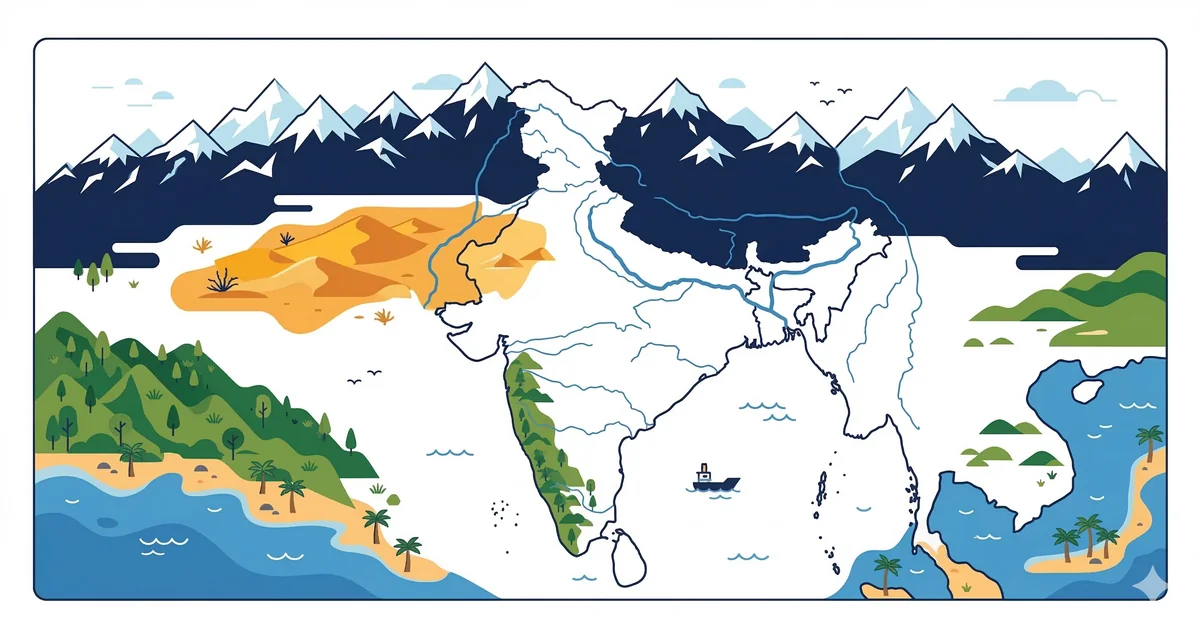
India experiences a Tropical Monsoon type of climate, primarily influenced by the Himalayas in the north and the Indian Ocean in the south.
The monsoon is not a single rain event but a seasonal reversal of winds. Understanding its mechanism is a high-yield area for UPSC and SSC examinations.
Indian climate and monsoon MCQ questions are among the most consistently asked in competitive exams. India has a monsoon-dominated climate with four seasons: Winter (Dec–Feb), Summer/Pre-monsoon (Mar–May), Southwest Monsoon (Jun–Sep), and Retreating Monsoon/Northeast Monsoon (Oct–Nov). The distribution of rainfall, the mechanism of the monsoon, and regional climate variations are all tested.
The Southwest Monsoon enters India from two branches: the Arabian Sea branch (hits Kerala by 1 June) and the Bay of Bengal branch (enters through Myanmar and NE India). Mawsynram and Cherrapunji (both in Meghalaya) receive the highest rainfall in India — Mawsynram holds the record for the highest average annual rainfall (~11,872 mm). Jaisalmer in Rajasthan receives the lowest rainfall (<100 mm/year).
India's eastern coast (Bay of Bengal) is more prone to cyclones than the western coast. October–December is the peak cyclone season for the eastern coast. Tamil Nadu and Andhra Pradesh are most affected. The Arabian Sea is seeing increasing cyclone frequency (Cyclone Tauktae 2021, Biparjoy 2023 affected Gujarat and Rajasthan). Cyclones are classified by wind speed: depression (<63 km/h), cyclonic storm (63–88), severe cyclonic storm, very severe, extremely severe, and super cyclonic storm.
Mawsynram in Meghalaya holds the record for the highest average annual rainfall (~11,872 mm), followed closely by Cherrapunji (Sohra) in the same state.
The SW Monsoon typically arrives at Kerala's coast by 1 June and covers the entire country by 15 July. It withdraws from northwest India by 1 September and retreats fully by October.
About the Author
Indian History · Geography · Polity & Economy Specialist
With 8+ years of teaching static GK for competitive exams, Priya has helped thousands of students master the foundational subjects that appear year after year in UPSC, SSC, and Railway exams. She focuses on making history, geography, and polity approachable through well-structured MCQs and memorable explanations.