1
Who is famously known as the 'Father of the Indian Space Programme'?
By Priya Sharma · Static GK Expert
A comprehensive collection of 20 high-quality multiple-choice questions covering the contributions and lives of eminent Indian scientists and inventors.
Who is famously known as the 'Father of the Indian Space Programme'?
Which Indian physicist was awarded the Nobel Prize in Physics in 1930 for his work on the scattering of light?
The 'Bose-Einstein Statistics' is named after Albert Einstein and which Indian scientist?
Who led India's first nuclear test, code-named 'Smiling Buddha', in 1974?
Which Indian scientist is known for inventing the crescograph, a device for measuring plant growth?
Who is known as the 'Missile Man of India'?
Which Indian mathematician is known for his extraordinary contributions to mathematical analysis, number theory, and infinite series?
The 'Bhabha Atomic Research Centre' (BARC) is located in which city?
Who is regarded as the 'Father of Indian Statistics'?
Who discovered the 'Chandrasekhar Limit', a crucial concept in the evolution of stars?
Which Indian chemist is famously known for his work in the field of mercury compounds and the establishment of the Bengal Chemicals and Pharmaceuticals?
Who was the first Indian woman to head a center at ISRO?
Which scientist is known as the 'Agni Putri' or 'Missile Woman of India'?
The 'Saha Ionization Equation' was formulated by which Indian astrophysicist?
Who was the first Director-General of the Council of Scientific and Industrial Research (CSIR)?
Which Indian biologist is known for her pioneering work in the field of meteorology and atmospheric physics?
Who was the first woman to earn a PhD in a scientific discipline in India?
Which scientist is known for his contribution to the 'Ramachandran Plot', used to understand protein structures?
Who was awarded the Nobel Prize in Physiology or Medicine in 1968 for his work on the genetic code?
Who is known as the father of modern Indian palaeobotany?
Dr. Shanti Swarup Bhatnagar, the first Director-General of CSIR, is primarily remembered for his research in which field?
The 'Chandrasekhar Limit' defines the maximum mass of which celestial object?
Who played a lead role in the development of India's indigenous supercomputer, 'PARAM 8000'?
Which Indian chemist is renowned for her research on the medicinal properties of plants, specifically the vinca alkaloids from the Periwinkle plant?
Which scientist is considered the 'Father of the Green Revolution in India'?
Which Indian physicist and inventor is known as the 'Father of Fiber Optics' for his pioneering work in the field of photonics?
The 'Bengal Chemicals and Pharmaceuticals', the first Indian pharmaceutical company, was established by whom?
Which Indian mathematician is known for his work in the field of 'Statistical Inference' and the 'Cramér-Rao bound'?
Which Indian physicist is credited with the invention of the 'Bose-Einstein Condensate' (in collaboration with Albert Einstein) and has a class of subatomic particles named after him?
Who was the chief architect of India's nuclear programme and the founder of the Tata Institute of Fundamental Research (TIFR)?
Who was the first Indian scientist to be elected as a Fellow of the Royal Society (FRS) in London?
Which Indian botanist is known for her work in cytogenetics and plant breeding, specifically for creating the 'Magnolia kobus' variety?
The 'Saha Ionization Equation' is a foundational concept in which field of study?
Who was the first woman to earn a PhD in chemistry from an Indian university (specifically from the University of Bombay)?
Which Indian scientist played a critical role in the development of India's first satellite, 'Aryabhata'?
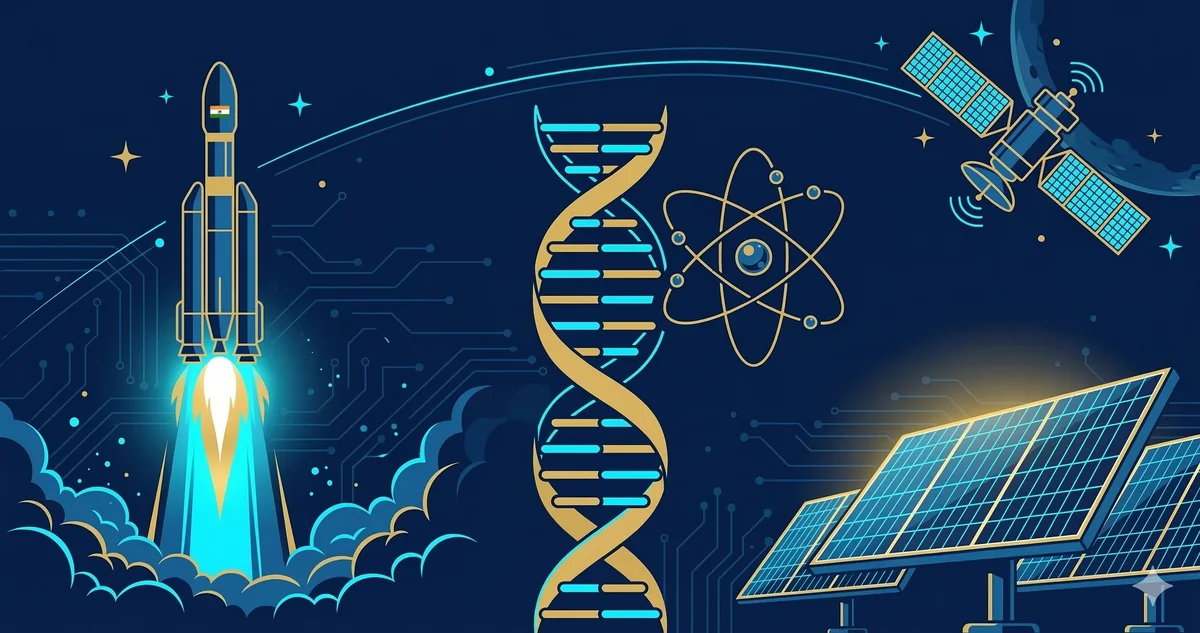
India has a rich heritage of scientific inquiry, evolving from ancient innovations to modern space and nuclear prowess. For competitive exams like UPSC and SSC, candidates must focus on key figures and their breakthrough contributions.
Modern Indian science is characterized by institution building and strategic breakthroughs that have positioned India as a global technological leader.
About the Author
Indian History · Geography · Polity & Economy Specialist
With 8+ years of teaching static GK for competitive exams, Priya has helped thousands of students master the foundational subjects that appear year after year in UPSC, SSC, and Railway exams. She focuses on making history, geography, and polity approachable through well-structured MCQs and memorable explanations.